Hungary Is Becoming Increasingly Toxic for the EU and NATO, with Viktor Orbán Turning It into a Major Source of Instability in Europe
The reason for Orbán’s Eurosceptic, anti-Ukrainian, and pro-Russian policies lies in his attempts to resolve Hungary’s economic problems through further economic cooperation with Russia and to shift the responsibility for his mistakes as Prime Minister onto the EU and Ukraine. This issue is becoming particularly relevant for him in view of the upcoming parliamentary elections in the country, which he and his party may lose due to their falling ratings. At the same time, his current policy is turning Hungary into a major source of instability in Europe, undermining its international position and further worsening the economic situation in the country. His actions against Ukraine, which is a key factor in Europe’s security system, are also disastrous.
During his tenure as Prime Minister, Viktor Orbán has traditionally pursued a pro-Russian and anti-Ukrainian policy, making him Russia’s main ally and Ukraine’s main opponent in Europe. This course of action violates European norms and principles, turning Hungary into one of the biggest problems for the EU and NATO. According to experts, Orbán is unable to ensure the normal economic development of his country because his government’s activities are not transparent. But yjr government cannot work properly due to corruption in the country’s power structures. Moreover, many corruption schemes are implemented jointly with Moscow or with its assistance. That is why further cooperation with Russia is fundamentally important for Orbán, because only in this way can he somehow keep the Hungarian economy afloat, in particular, thanks to access to the Russian market and energy resources, which are cheaper than European or American ones. At the same time, such cooperation involves corruption schemes and, possibly, personal enrichment.
This explains why Orbán refuses to diversify the sources and routes of oil and gas supplies to Hungary, even though this contradicts the European Union’s policy of reducing dependence on Russian energy resources. The EU and most European countries began to take steps in this direction in the second half of the 2000s due to Russia’s gas wars against Ukraine and Europe. And after Russia’s full-scale attack on Ukraine in 2022, they quickly gave up most of their Russian hydrocarbons, which allowed them to put severe pressure on Putin’s regime over the Ukrainian issue.
Unlike them, Hungary has not left Russia’s energy space, which is why it is forced to follow Russian policy. Moscow is currently exploiting Hungary to the fullest extent for its own interests. This is especially true after Donald Trump changed his attitude to Russia in October, further undermining its international position.
As the full-scale Russian-Ukrainian war continues, Hungary is becoming one of Russia’s main tools for weakening Ukraine and undermining the unity of the EU and NATO. Viktor Orbán refuses to cooperate with Ukraine on defense, tries to block EU and NATO decisions to provide assistance to Ukraine, and seeks to help weaken sanctions pressure on Putin’s regime. Besides, Orbán is hindering Ukraine’s European and Euro-Atlantic integration processes.
However, Orbán’s anti-Ukrainian policy is not only driven by his interests in Russia and Hungary’s dependence on it. He is also trying to shift the responsibility for his country’s socio-economic problems onto Ukraine and justify his inability to deal with them due to, so to speak, external reasons.
Orbán cites Europe’s excessive spending on supporting Ukraine and strengthening European security, which is depleting the EU’s financial resources, as the main reasons for this. As a result, the EU is forced to reduce funding for programs to develop the European economy, provide social security for the population, and resolve other pressing problems. According to the Hungarian Prime Minister, aid to Ukraine does not bring any positive results, but only prolongs the war and exacerbates relations between Europe and Russia. At this, he is trying to convince Europeans that Moscow does not have sufficient forces to further attack Europe, and therefore European spending on strengthening defense is futile.
Orbán also explains that Hungary’s economic difficulties arose because of the the war in Ukraine and EU sanctions against Russia, which, starting in 2022, amounted to almost EUR 23 billion. Of this amount, EUR 16 billion – additional expenditure due to rising energy prices, EUR 5 billion – military inflation, and EUR 2-2.5 billion – losses incurred by Hungarian companies due to the cessation of trade with Russia.
The need to justify Hungary’s economic woes is very important for V. Orbán. After all, parliamentary elections are scheduled to take place in the country in April next year. He and his Fidesz party may lose them due to a loss of trust on the part of the Hungarian population. Currently, the main opposition party, Tisza, is already ahead of Fidesz and is increasing its electoral lead. This trend is quite obvious and is a consequence of the decline in the standard of living of Hungarians, as well as Budapest’s anti-Ukrainian and pro-Russian policies, which are increasingly unpopular with citizens.
This poses a direct threat to V. Orbán, as he may not just lose his power and wealth, but face criminal prosecution by the new government, which will undoubtedly accuse him of involvement in corruption. He is also likely to be blamed for his political course, as the current Hungarian opposition has pro-Western positions.
In this regard, Orbán is trying to boost his rating by demonstrating his role and importance in international politics, including the settlement of the “Ukrainian crisis”. As is well known, last year he put forward his plan for resolving this issue, which envisages Ukraine’s de facto capitulation to Russia. At the same time, he tried to push it through during visits to the USA, Ukraine, and Russia and meetings with Donald Trump, Volodymyr Zelenskyy, and Vladimir Putin. To this end, Orbán used his personal relationships with Trump and Putin, which he believes to be positive.
As expected, Ukraine did not agree with Orbán’s initiatives, and therefore his efforts failed. However, he did not give up his attempts to join the peace settlement process in Ukraine, but in fact, to promote the Russian “option” for ending the war. In this regard, Orbán had high hopes for the planned meeting between Trump and Putin in Budapest in October. If it had taken place, Orbán could have been the host and presented himself to Hungarians and the world as an influential politician on a par with world leaders. And if Trump and Putin had agreed to end the war in Ukraine, he would have been involved in this and gone down in history.
However, this never happened. Due to Putin’s refusal to stop the war along the current front line and his unacceptable demands on Ukraine, D. Trump refused to meet with him. Moreover, he completely changed his attitude to Russia and imposed sanctions against Russian oil companies “Lukoil” and “Rosneft”. As a result, Orbán not only failed to boost his electoral rating, but also faced the prospect of secondary sanctions against Hungary by the USA, which would have been a significant blow to both its economy and his personal authority.
To prevent this from happening, Orbán secured an urgent meeting with D. Trump on November 7 in Washington. According to him, he persuaded the US President to allow Hungary to buy Russian oil and also received guarantees from him regarding financial assistance in case of an economic crisis in the country.
Trump did indeed allow the purchase of Russian oil, but only for one year, which in no way corresponds to the strategic goals of the Hungarian Prime Minister. Plus, Orbán was forced to agree to purchase American energy resources, which undermines his corruption schemes.
Such achievements are presented by Hungary’s official propaganda as Orbán’s victory and proof of the effectiveness of his policies. Based on this, the authorities are convincing citizens of the need to support him and his Fidesz party in the elections. However, in reality, he is increasingly driving himself and Hungary into a dead end, undermining its international position and slowing down economic development.
Orbán’s actions have already made Hungary toxic for the EU and NATO and are increasingly turning it into a pariah state in Europe. In response to the blocking of European Union and North Atlantic Alliance decisions concerning Ukraine and Russia, the leaderships of these organizations have begun to look for ways to exclude Hungary from the processes of their preparation and adoption. Such intentions are already being successfully implemented in practice.
Central and Eastern European countries are also distancing themselves from it. This applies even to those that have taken similar positions on Ukrainian and Russian issues, in particular Slovakia and the Czech Republic. As is well known, Slovakia began pursuing an anti-Ukrainian and pro-Russian policy after the populist SMER party led by R. Fico won the 2023 parliamentary elections. Similar shifts are taking place in the Czech Republic’s foreign policy, as a result of the Eurosceptic ANO movement, led by former Prime Minister Andrej Babiš, winning a majority of votes in October. However, both Slovakia and the Czech Republic rejected Orbán’s proposal to create a kind of anti-Ukrainian bloc with their participation.
An even greater blow to Orbán and Hungary was the EU sanctions for the spread of corruption in the country’s government bodies and their violation of European norms and rules. In particular, the European Union blocked EUR 20 billion in financial aid to Hungary, which created a real threat of a critical deterioration of the economic situation in the country. Hungary is now also beginning to fall out of the new Euro-Atlantic and European security system being built by America and Europe. Ukraine plays a key role in this system, as it is considered one of the main forces in containing Russia. Budapest’s actions are hindering Ukraine in this regard. In doing so, Hungary is directly undermining the Western world’s defense capabilities at a time of increasing military threats to its security from Moscow.
The negative consequences of Orbán’s actions, which are destroying stability in Europe and Hungary’s prosperity and position for the sake of his personal interests, have long been understood by the majority of Hungarians themselves, as well as by the leaderships of the EU and NATO, and, obviously, by US President Donald Trump. Therefore, Orbán has no future.
Thus, Prime Minister of Hungary Viktor Orbán continues his attempts to boost his popularity in the country and resolve its economic problems through Eurosceptic, pro-Russian, and anti-Ukrainian policies. However, such attempts and efforts are yielding diametrically opposite results. Under his leadership, Hungary has become a virtual outcast in the EU, lost its position in Central and Eastern Europe, remains energy dependent on Russia, and faces the threat of an economic crisis.
Budapest’s actions complicate the European Union and NATO’s ability to build a new European security system and provide military assistance to Ukraine, and slow down the process of its European integration. In addition, Donald Trump’s agreement to allow Hungary to purchase Russian oil allows Russia to maintain its position in the European energy market and generate revenue.
The development of the political situation in Hungary opens up real prospects for a change of power in the country following the parliamentary elections in the spring of next year. Until then, Hungary, with its destructive policies, will remain a major source of problems and instability in Europe. And Budapest’s creation of obstacles for Ukraine in its cooperation with the EU and NATO in the security sphere undermines Hungary’s own position in Central and Eastern Europe.
Yurii Mykhailenko,
Institute for Global Politics
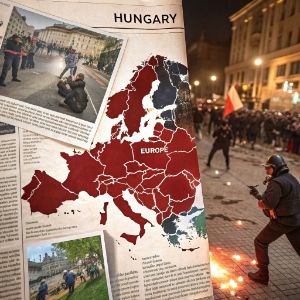
(Image generated by neural network)